
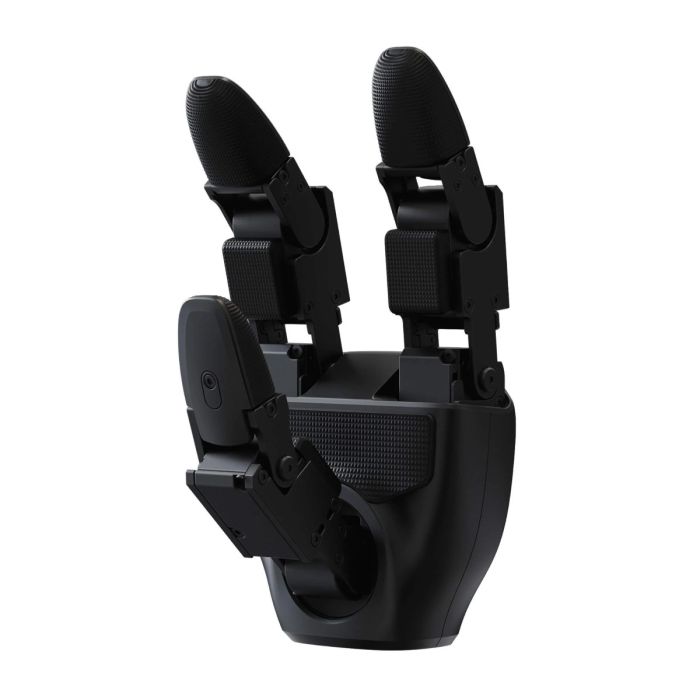
Unitree G1 Dex3-1 Force Control Three Finger Dexterity Hand
In stock
- BRAND:
- UNITREE ROBOTICS
- PART #:
- G1-DEX3-3FINGERHAND
- ORIGIN:
- China
- AVAILABILITY:
- SUBJECT TO AVAILABILITY
- SKU:
- Unitree-G1-DEX3-1
Unitree G1 Dex3-1 Force Control Three Finger Dexterity Hand
A humanoid robot can cross a laboratory, turn towards a cup and lift its arm with real poise, yet the outcome of the whole manoeuvre is decided in the last few centimetres, where fingers meet the object. Too little pressure and the cup slips; too much and a paper cup folds in on itself. The Unitree G1 Dex3-1 Force Control Three Finger Dexterity Hand is Unitree's answer to that final stretch on the G1 humanoid: a compact end effector that pairs force and position hybrid control with tactile sensing, so that the robot measures contact instead of inferring it from joint angles alone.
Robots Europa, based in Dublin, supplies the Dex3-1 to universities, research institutes, system integrators and industrial development teams across the European Union and the DACH region. Robots Europa prepares the quotation, arranges delivery and provides support for the hand, whether it is ordered to equip an existing G1 or as part of a larger humanoid programme.
Background
Unitree Robotics and the G1 platform
Unitree Robotics built its reputation on agile legged robots before extending its range to full-size and compact humanoids. The G1 sits in that humanoid line as a platform aimed largely at research, teaching and development work, where teams need a robot they can programme, instrument and push into new tasks. A humanoid of this kind is only as useful as its hands, because most of the tasks people imagine for it, from sorting parts to handling tools, end in a grasp. The Dex3-1 is the dexterous hand Unitree designed to be used with the G1 humanoid robot to perform complex actions, giving the platform an end effector that belongs to the same ecosystem rather than an adapted third-party component.
Tactile sensing and hybrid control
Two technologies define the Dex3-1. The first is its actuation: seven degrees of freedom driven by micro brushless force control joints, six of them in direct drive and one through a gear drive. Direct drive keeps the path between motor and finger short, which favours responsiveness and makes the forces at the finger easier to read and regulate. The second is its sense of touch: one hand carries 33 tactile sensors, with a range of perception of 10g-2500g. Combined with force and position hybrid control, this lets the hand move to a target posture while also governing how firmly it presses once contact is made. Each joint reports its position through a rotor absolute value encoder, so the controller knows where the fingers are at power-up without a homing routine.
Technical Specifications
| Specification | Value |
|---|---|
| Type | Three-finger dexterous hand |
| Degrees of freedom | 7 |
| Actuators | 6 micro brushless force control joints with direct drive, 1 micro brushless force control joint with gear drive |
| Transmission mechanism | 6 Motors Drive Directly, 1 Motor Drive with Gears |
| Tactile sensors | 33 per hand |
| Number of pressure sensors | 9 (Total of 33 Pressure Sensors) |
| Range of perception | 10g-2500g |
| Control method | Force and position hybrid control |
| Joint encoder | Rotor Absolute Value Encoder |
| Size | 175mm x 88mm x 77mm |
| Working temperature range | -20℃ ~ 60℃ |
| Compatible robot | G1 humanoid robot |
Specifications are given as published by the manufacturer and are confirmed against the datasheet at quotation.
Unitree has not published the box contents, the ingress protection (IP) rating, the grip force or the finger speed of the hand; these points are clarified with Robots Europa at quotation.
How does force and position hybrid control change grasping?
A hand governed by position alone works like a sequence of instructions: close this joint to that angle, then stop. That is adequate when the object is rigid, its size is known and it sits exactly where the program expects. Real objects rarely behave so politely. A soft pouch deforms, a component sits a few millimetres off its nominal position, a glass is more fragile than the gripper assumes. Under pure position control, any of these deviations turns into either a missed grasp or excessive pressure.
Force and position hybrid control divides the task more sensibly. The hand uses position to approach and shape itself around the object, then switches its attention to force once the fingers touch. The 33 tactile sensors on each hand tell the controller where contact has occurred and how strongly, across a perception range of 10g-2500g, so a light touch and a firm hold can both be registered. The direct-drive joints help here, because force applied at the finger passes back to the motor with little mechanical filtering. For researchers this means grasps that can be tuned, logged and repeated; for integrators it means a hand that tolerates the variation found outside a perfectly prepared test bench.
Why three fingers rather than five?
It is tempting to assume that a more human-looking hand is automatically a better one. In practice, much everyday manipulation relies on an opposing thumb working against one or two fingers, and a three-finger layout covers a large share of pinch, tripod and enveloping grasps. Fewer digits mean fewer actuators to coordinate, fewer sensors to calibrate and a simpler control problem, which matters when a team wants to spend its time on manipulation strategies rather than on managing the hand itself.
The Dex3-1 concentrates its seven degrees of freedom and its tactile coverage on those three digits, keeping the hand within a compact envelope of 175mm x 88mm x 77mm. For work that genuinely demands an anthropomorphic hand, such as studies of human-like in-hand manipulation, Unitree offers other designs; for the many projects where reliable, sensed grasping on the G1 is the goal, the three-finger approach is a deliberate choice rather than a compromise.
Who is the Dex3-1 hand for?
The first group is research laboratories working on robotic manipulation, embodied AI and learning from demonstration. The combination of tactile data, absolute joint encoders and hybrid control gives them rich, structured signals from every grasp, which is precisely what training and evaluation pipelines need. The second group is universities and technical colleges that already teach with the G1 and want students to progress from locomotion to manipulation on the same platform.
System integrators and industrial innovation teams form the third group. They use the Dex3-1 to prototype handling, assembly and inspection tasks on a humanoid before committing to a production concept, and its working temperature range of -20℃ ~ 60℃ is a useful reference when planning trials beyond a heated laboratory.
The Dex3-1 is designed for the G1, so owners of other platforms should look elsewhere: teams working with the H1-2 humanoid will find the matching option in the Unitree H1-2 Dexterous Hand. Projects that call for a more anthropomorphic, five-fingered design should compare the Unitree Dex5-S Pro Tactile Dexterous Hand, and G1 owners who prefer an alternative end effector can review the Unitree G1 Third-Party Dexterity (One-Handed). The full range is collected in the Hands category, and further add-ons for the robot are listed under Humanoid Accessories.
What is the Dex3-1 hand used for?
- Manipulation research: studying grasp planning, regrasping and contact-rich tasks with measured fingertip forces.
- Robot learning datasets: recording tactile, position and force data to train and benchmark manipulation policies.
- Teaching and coursework: giving students hands-on experience of hybrid control and tactile feedback on a real humanoid.
- Handling of delicate objects: picking items that deform or break under excessive pressure, such as packaging or laboratory consumables.
- Assembly and logistics prototyping: testing whether a humanoid can take over picking, placing and simple assembly steps.
- Human–robot interaction studies: exploring hand-overs and shared tasks where gentle, controlled contact is essential.
Pricing and Availability
Robots Europa supplies the Unitree G1 Dex3-1 on a quotation basis, so that the offer reflects your G1 configuration, the number of hands required and the intended application. Delivery, customs and support are arranged together with the quotation. If you have questions about integration with your existing robot, our team will address them before you order. The request form for a personalised quotation is available on this page.
Frequently Asked Questions
Which robot does the Dex3-1 work with?
The Dex3-1 is designed to be used with the Unitree G1 humanoid robot. If you operate a different platform, Robots Europa can advise on the hand that matches it.
How many degrees of freedom does the hand have?
The hand has 7 degrees of freedom. Six joints are micro brushless force control joints in direct drive, and one uses a gear drive.
How many tactile sensors does the Dex3-1 carry?
One hand carries 33 tactile sensors. The pressure sensor count is given as 9, with a total of 33 pressure sensors.
What forces can the sensors detect?
The range of perception is 10g-2500g. This covers both light contact and firmer grasps.
In which temperatures can the hand operate?
The working temperature range is -20℃ ~ 60℃. This allows trials in unheated halls as well as in the laboratory.
How does the hand know the position of its fingers?
Each joint uses a rotor absolute value encoder. The controller therefore knows the finger positions as soon as the hand is powered up.
Where can I buy the Unitree G1 Dex3-1 Force Control Three Finger Dexterity Hand and what does it cost?
You can buy it from Robots Europa, which supplies customers across the EU and the DACH region. The price depends on your configuration and is set out in a personalised quotation that you can request on this page.
Summary
Walking, balance and perception bring a humanoid to the object; the hand decides whether the task succeeds. The Unitree G1 Dex3-1 addresses that decisive moment with seven degrees of freedom, direct-drive force control joints, 33 tactile sensors per hand and force and position hybrid control, all within a compact housing designed for the G1. It suits research groups, teaching programmes and integrators who want sensed, repeatable grasping rather than blind closure, while other Unitree hands serve other platforms and more anthropomorphic requirements. Robots Europa quotes, delivers and supports the hand from Dublin across the EU and the DACH region. For anyone planning to give a G1 a sense of touch, this page is the starting point.
Specifications
General
What's included
Related Products
Out of stock


