Deep Robotics Lite3 Basic Quadruped Robot Dog

In stock
- BRAND:
- DEEP ROBOTICS
- PART #:
- Lite3
- ORIGIN:
- China
- AVAILABILITY:
- ALLOW 2-4 WEEKS FOR DELIVERY
- SKU:
- Deep-Robotics-Lite3-Basic
Deep Robotics Lite3 Basic Quadruped Robot Dog
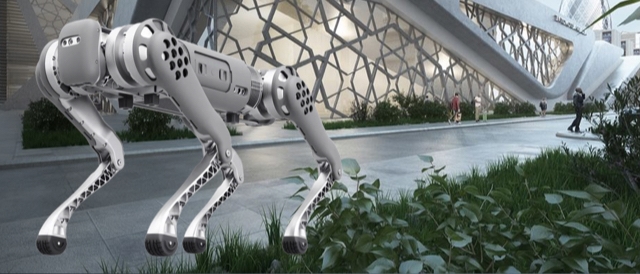
Legged locomotion is simple to sketch on a whiteboard and stubbornly hard to grasp until a real machine shifts its weight, misjudges a step and recovers. The Deep Robotics Lite3 Basic Quadruped Robot Dog is built for that second kind of learning. It is a compact four-legged robot that a lecturer can set down on the laboratory floor, that students can program through an open SDK, and that, at 12 kg, can be carried from one teaching room to the next. As the entry configuration of the Lite3 family, it concentrates on motion control rather than on onboard perception computing. Students therefore meet the fundamentals of walking, balance and control before the complexity of a full autonomy stack.
Robots Europa, based in Dublin, sells and supplies the Lite3 Basic to universities, colleges, research institutes and companies across the European Union and the DACH region. Robots Europa prepares each quotation, arranges delivery to your institution and remains your point of contact for technical support once the robot is in service in your laboratory or classroom.
Background
DEEP Robotics and the Lite3 platform
DEEP Robotics develops legged robots for several fields of use, from compact research platforms to larger industrial machines. The Lite3 is its high-performance quadruped for academic research, reinforcement learning experiments and robotics education. The platform is offered in several versions: Basic, Basic AI, Venture, Pro and LiDAR. Each version shares the Lite3 body and software foundation but is equipped for a different depth of work. An overview of the family is available on the Deep Robotics Lite3 Academic & Research Quadruped Robot Dog page, and the wider range can be explored in our Standard Quadrupeds category.
The Basic is positioned for entry-level robotics education and motion control learning. It is the configuration for teams whose first question is how a four-legged robot stands, walks and keeps its footing, rather than how it maps a building.
Motion host, joint torque and modularity
Motion on the Lite3 is handled by a motion host built on an RK3588 ARM-architecture processor. The Lite3 delivers joint torque up 50%, together with faster response bandwidth and precise motion control. For a teaching or research robot, this matters. A controller that responds quickly and accurately gives students and researchers a clearer link between the commands they write and the movement they observe.
The Lite3 also has an adaptable modular design that supports a wide range of additional functional modules. A department can therefore begin with the core robot and extend it as its curriculum or research programme develops, instead of committing to a fully equipped system on the first day.
Technical Specifications
| Specification | Value |
|---|---|
| Version | Basic |
| Standing dimensions (L × W × H) | 610 × 370 × 406 mm |
| Weight | 12 kg |
| Payload capacity | 5 kg |
| Maximum slope | 40° |
| Obstacle clearance | 18 cm |
| Continuous operation | 1.5 – 2 hours |
| Maximum range | 5 km |
| Perception features | Front/rear obstacle stop; visual following |
| Motion host processor | RK3588 ARM-architecture processor |
| Operating system | Ubuntu 20.04 |
| ROS compatibility | ROS1 (Noetic) and ROS2 (Foxy) |
| Development access | Open SDK and API for secondary motion and perception development |
| Joint torque | Up 50% |
| Protection | Overtemperature protection: stops and lies down if motors overheat |
Specifications are as published by the manufacturer and are confirmed against the datasheet at quotation.
DEEP Robotics has not published the maximum speed, battery capacity, charging time, IP rating, operating temperature range, degrees of freedom, wireless connectivity or box contents for this version; Robots Europa confirms these details with your quotation.
How does the Lite3 Basic differ from the Pro and LiDAR versions?
The clearest difference lies in onboard computing. The Pro and LiDAR versions carry an NVIDIA Jetson Xavier NX perception host alongside the RK3588 motion host. The Basic does not carry that perception host. Its perception features are front and rear obstacle stop and visual following, and its hardware interfaces are given as N/A for this configuration.
This defines the Basic's purpose. It is a locomotion and control platform first. The robot can stop for obstacles ahead or behind and follow a person visually, which is enough for supervised classroom sessions and demonstrations. It is not specified as a mapping or autonomous navigation machine. Teams whose research depends on heavy onboard perception, such as running vision models on the robot or working with LiDAR data, will find the Deep Robotics Lite3 Pro Quadruped Robot Dog or the Deep Robotics Lite3 LIDAR Quadruped Robot Dog a better fit. For the Basic's core audience, the narrower scope is an advantage: fewer subsystems to configure means more lesson time spent on the motion itself.
Can the Lite3 Basic be programmed with ROS1 and ROS2?
Yes. The Lite3 runs on Ubuntu 20.04 and is compatible with both ROS1 (Noetic) and ROS2 (Foxy). Open SDK and API access allows secondary motion and perception development on both ROS generations. A department that still teaches with ROS1 can keep its existing course material, while a research group that has moved to ROS2 can work with the same robot without changing platform.
Open access also matters for the robot's long-term value. Students can go beyond pre-programmed behaviours, write their own controllers, test them on real hardware and compare the results with simulation. Overtemperature protection provides a sensible safeguard during intensive sessions: if the motors overheat, the robot stops automatically and lies down instead of continuing under strain.
Who is the Lite3 Basic for?
The Lite3 Basic suits university and college departments that teach robotics, mechatronics or control engineering and want students to work with a real quadruped rather than only with simulations. It also fits research groups whose focus is locomotion: reinforcement learning for gaits, balance control or terrain response, where motion performance matters more than onboard perception. Technical schools and training centres that introduce ROS will find a platform supporting both ROS1 and ROS2 on Ubuntu 20.04, so one robot can serve more than one course.
Laboratories that plan to move into perception, navigation or sensor fusion should compare the Basic with the Pro and LiDAR versions, which carry the dedicated perception host. The Deep Robotics Lite3 Venture Quadruped Robot Dog is another member of the family, and Robots Europa can advise on which configuration best matches your programme when preparing the quotation.
What is the Lite3 Basic used for?
- Motion control teaching: students observe how commands become gait, balance and posture on a physical quadruped.
- Reinforcement learning experiments: researchers transfer locomotion policies from simulation to a real robot through the open SDK.
- ROS coursework: lessons in ROS1 (Noetic) or ROS2 (Foxy) on Ubuntu 20.04 use a real legged robot as the target.
- Terrain and gait testing: controllers are evaluated on slopes of up to 40° and over obstacles of up to 18 cm.
- Human–robot interaction demonstrations: visual following and front/rear obstacle stop support supervised demonstrations with people.
- Payload and module trials: the modular design and 5 kg payload allow additional functional modules to be tested.
Pricing and Availability
Robots Europa supplies the Lite3 Basic on the basis of an individual quotation, prepared for your institution and your intended use. Delivery, customs clearance and technical support are arranged together with the quotation. We can also discuss the differences between the Lite3 versions, so that your department invests in the configuration that matches its teaching or research goals. You can request a quotation using the enquiry options available on this page.
Frequently Asked Questions
What payload can the Lite3 Basic carry?
The Lite3 Basic has a payload capacity of 5 kg. That allows additional modules or test equipment to be mounted for experiments.
How long does the Lite3 Basic run continuously?
Continuous operation is 1.5 – 2 hours, and the maximum range is 5 km.
Which operating system and ROS versions does it support?
The Lite3 runs on Ubuntu 20.04 and is compatible with ROS1 (Noetic) and ROS2 (Foxy). An open SDK and API support secondary motion and perception development on both.
Does the Basic include the NVIDIA Jetson perception host?
No. The NVIDIA Jetson Xavier NX perception host is fitted to the Pro and LiDAR versions. The Basic uses the RK3588 motion host.
What happens if the motors overheat?
The Lite3 has overtemperature protection. If the motors overheat, the robot stops automatically and lies down.
What terrain can the Lite3 Basic handle?
The Lite3 Basic climbs slopes of up to 40° and clears obstacles of up to 18 cm. Front and rear obstacle stop halts the robot when something is in its path.
Where can I buy the Deep Robotics Lite3 Basic and what does it cost?
You can buy the Lite3 Basic from Robots Europa, which supplies customers across the EU and the DACH region. The cost is set out in an individual quotation, which you can request on this page.
Summary
Understanding legged locomotion begins when a real robot takes its first uncertain step on your floor. The Lite3 Basic offers that step at the entry point of the Lite3 family. It combines a portable 12 kg body, a 5 kg payload, a 40° slope capability and 1.5 – 2 hours of continuous operation with an RK3588 motion host and open SDK access on ROS1 and ROS2. It deliberately leaves the heavier perception computing to the Pro and LiDAR versions, keeping the focus on motion control, gait research and teaching. For departments that want students and researchers to learn locomotion on real hardware, with Robots Europa handling quotation, delivery and support, this page is the starting point.
Specifications
General
Physical
Performance
Software
Battery + Power
What's included
Downloads
Related Products
Out of stock