
Deep Robotics Lite3 LIDAR Quadruped Robot Dog
In stock
- BRAND:
- DEEP ROBOTICS
- PART #:
- Lite3 Venture
- ORIGIN:
- China
- AVAILABILITY:
- ALLOW 2-4 WEEKS FOR DELIVERY
- SKU:
- Deep-Robotics-Lite3-LIDAR
Deep Robotics Lite3 LIDAR Quadruped Robot Dog
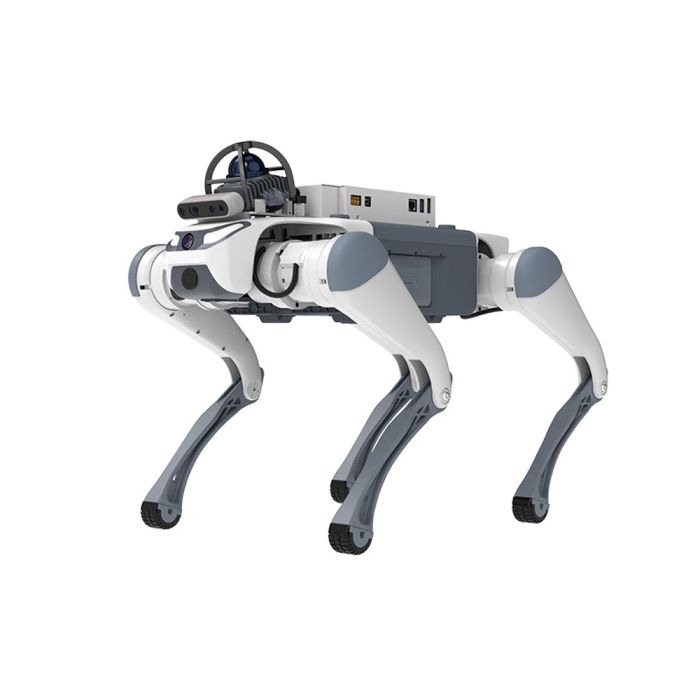
Most legged robots are judged by how they walk: the slope they can climb, the step they can clear, how calmly they recover from a stumble. The Deep Robotics Lite3 LIDAR Quadruped Robot Dog must also answer a second question. Once it has walked somewhere, does it know where it is? This configuration of the Lite3 combines a LiDAR module, an Intel RealSense D435i depth camera and a dedicated NVIDIA Jetson Xavier NX perception host with a compact quadruped built for academic research, reinforcement learning experiments and robotics education. The result is a capable walker that can also map a space, localise itself within it and plan its own route.
Robots Europa, based in Dublin, supplies the Lite3 LIDAR to universities, research institutes and technology companies across the European Union and the DACH region. We prepare the quotation, arrange delivery to your site and remain your point of contact for support once the robot is in use. A laboratory in Munich, Zurich or Lyon therefore works with one European partner from the first enquiry onwards.
Background
DEEP Robotics and the Lite3 family
DEEP Robotics designs quadruped robots for both research and professional use. The Lite3 is its compact research platform. The manufacturer offers it in four versions: Basic, Venture, Pro and LIDAR. You can view them side by side in our Lite Series. Every version is aimed at the same readership: researchers, lecturers and developers who need a legged robot that can be opened up, programmed and extended rather than simply operated. The software foundation reflects this. The Lite3 runs Ubuntu 20.04 and works in both ROS1 (Noetic) and ROS2 (Foxy) environments. A Motion SDK with example code and libraries is available in the Lite3 Motion SDK repository on GitHub.
The mechanical design follows the same thinking. With a 50% boost in joint torque, the Lite3 achieves high torque density, rapid response bandwidth and high reverse transmission efficiency. This translates into smoother, more precise movement across varied terrain. For a research team, this means locomotion experiments are less limited by the actuators and more by the quality of the controller under test.
Two computers, one robot
The Lite3 LIDAR has two separate computers. An RK3588 ARM-architecture processor serves as the motion host, and an NVIDIA Jetson Xavier NX serves as the perception host. The Jetson perception host is specific to the Pro and LIDAR versions. Research robots often use this division because it keeps time-critical gait control apart from the heavier work of processing point clouds and camera images. A mapping algorithm that briefly saturates its processor should not disturb the legs underneath it. For students, the arrangement also gives a clear model of how modern autonomous systems are structured. One layer keeps the machine upright and moving. Another layer interprets the world and decides where to go.
Technical Specifications
| Specification | Value |
|---|---|
| Standing dimensions (L × W × H) | 610 × 370 × 496 mm |
| Weight | 13.5 kg |
| Payload capacity | 2.5 kg |
| Maximum slope | 40° |
| Obstacle clearance | 18 cm |
| Continuous operation | 1.5 – 2 hours |
| Maximum range | 2.7 km |
| Motion host | RK3588 ARM-architecture processor |
| Perception host | NVIDIA Jetson Xavier NX |
| Depth camera | Intel RealSense D435i |
| LiDAR module | Livox or Leishen |
| Perception features | Front/rear obstacle stop, visual following, forward obstacle avoidance, autonomous navigation |
| Interfaces | USB 3.0, HDMI, Ethernet; External Power Input (24V/12V/5V); Power Connector |
| Operating system | Ubuntu 20.04 |
| ROS compatibility | ROS1 (Noetic), ROS2 (Foxy) |
| Protection | Overtemperature protection: stops and lies down if the motors overheat |
Specifications are as published by the manufacturer and are confirmed against the datasheet at quotation.
The manufacturer has not published the IP rating, the maximum speed of this version, the battery capacity, the range of the LiDAR or a service life, so we confirm these points with you at quotation.
What does the LIDAR version add to the Lite3?
Its main addition is the ability to navigate. The perception features of the Lite3 LIDAR cover front and rear obstacle stop, visual following and forward obstacle avoidance, and they culminate in autonomous navigation. The robot does not only avoid what is directly ahead of it. It can build a model of its surroundings and move through that model towards a goal.
Two sensors make this possible. The Intel RealSense D435i depth camera provides dense, close-range depth images. The LiDAR module, from Livox or Leishen, supports 3D mapping, localisation and environmental reconstruction. Together they give researchers the data needed for the core problems of mobile autonomy: where the robot is, what surrounds it, and which path is safe. The Jetson Xavier NX perception host processes this data on board, so experiments do not depend on a tethered workstation.
For a buyer comparing versions, the question is how much of the research programme involves perception. A team working purely on gait control may never use the LiDAR. A team working on mapping, localisation or navigation will want it from the first day of the project.
How well does the Lite3 LIDAR fit into an existing ROS workflow?
It fits well. Ubuntu 20.04 with ROS1 (Noetic) and ROS2 (Foxy) covers the two ROS generations most university laboratories work with. A group can keep its established Noetic packages while new projects move to Foxy. The Motion SDK and its example code give a documented entry point to locomotion control, so students can start from working examples rather than a blank file.
The hardware interfaces are designed for additional equipment. USB 3.0, HDMI and Ethernet connect peripherals, displays and networks. The external power input supplies 24V, 12V and 5V for added sensors or computing modules. With a payload capacity of 2.5 kg, the robot can carry a modest instrument package, such as an extra sensor, a radio or a small manipulator prototype, as long as the combined mass stays within that limit.
Overtemperature protection is useful during long test sessions. If the motors overheat, the robot stops and lies down instead of continuing under strain. This helps protect both the hardware and the experiment when a student leaves a demanding routine running.
Who is the Deep Robotics Lite3 LIDAR Quadruped Robot Dog for?
The first group is university robotics departments and research institutes working on simultaneous localisation and mapping, path planning and autonomous navigation on legged platforms. For them, the combination of LiDAR, depth camera and on-board perception computer is the main reason to choose this version. The second group is reinforcement learning researchers who want to deploy trained policies on a physical quadruped and combine locomotion with perception-driven behaviour. The third group is lecturers who run robotics courses and want one platform that can support teaching from basic motion control through to full autonomy.
Industrial research and development teams also belong here. Before committing to a larger platform, they often need a compact robot on which to prototype navigation software, test sensor integrations or demonstrate a concept to stakeholders.
Not every buyer needs the full perception package. If your work centres on locomotion, control theory or introductory teaching, compare the Deep Robotics Lite3 Basic Quadruped Robot Dog and the Deep Robotics Lite3 Venture Quadruped Robot Dog as well. The Deep Robotics Lite3 Pro Quadruped Robot Dog shares the Jetson Xavier NX perception host, and our team will gladly explain how the configurations differ. Other legged platforms are listed under Standard Quadrupeds.
What is the Deep Robotics Lite3 LIDAR Quadruped Robot Dog used for?
- Mapping and localisation research: building 3D maps of indoor and outdoor spaces from LiDAR and depth data.
- Autonomous navigation studies: developing and benchmarking path-planning algorithms on a legged robot.
- Reinforcement learning on hardware: moving trained locomotion and behaviour policies from simulation onto a physical platform.
- Robotics teaching: guiding students from motion control through perception to full autonomy on one robot.
- Perception algorithm development: testing obstacle avoidance, visual following and scene reconstruction with on-board computing.
- Sensor and payload prototyping: integrating additional instruments through the robot's interfaces and external power input.
Pricing and Availability
Robots Europa supplies the Lite3 LIDAR on a quotation basis, so that the configuration, the LiDAR module and any accessories match your project before you commit. Delivery, customs and support are arranged with the quotation. If you are planning a research grant, a teaching laboratory or a navigation project, tell us about your requirements through the quotation request available on this page.
Frequently Asked Questions
Which LiDAR is fitted to the Lite3 LIDAR?
The Lite3 integrates a LiDAR module from Livox or Leishen. It is used for 3D mapping, localisation and environmental reconstruction.
How long does the robot operate on one charge?
Continuous operation is 1.5 – 2 hours. The actual runtime depends on terrain, payload and the computing load of your software.
Does the Lite3 LIDAR support ROS2?
Yes. It runs Ubuntu 20.04 and is compatible with ROS2 (Foxy) as well as ROS1 (Noetic).
How much can the robot carry?
The payload capacity is 2.5 kg. Additional sensors can be powered through the external power input at 24V, 12V or 5V.
What happens if the motors overheat?
Overtemperature protection stops the robot and makes it lie down, which protects the drives until they have cooled.
Which computers does the Lite3 LIDAR use?
An RK3588 ARM-architecture processor runs the motion host, and an NVIDIA Jetson Xavier NX runs the perception host. This keeps gait control separate from sensor processing.
Where can I buy the Deep Robotics Lite3 LIDAR Quadruped Robot Dog and what does it cost?
You can buy it from Robots Europa, which supplies customers across the EU and the DACH region from Dublin. The cost depends on configuration and delivery, and we set it out in a quotation prepared for your project.
Summary
Walking well is only half of what a research quadruped has to offer. The Lite3 LIDAR adds the other half: a LiDAR module, an Intel RealSense D435i and a separate Jetson Xavier NX perception host. Together they allow the robot to map its surroundings, localise itself and navigate on its own. These capabilities sit on a compact body that climbs slopes of 40°, clears obstacles of 18 cm and runs on Ubuntu 20.04 with ROS1 and ROS2. This makes it a platform on which a laboratory can study both locomotion and autonomy without changing hardware. Robots Europa handles the quotation, delivery and support across Europe. To start your project with the Lite3 LIDAR, this page is the starting point.
Specifications
General
Physical
Performance
Software
What's included
Downloads
Related Products
Out of stock


